Hey Fans!
Just found this video explaining one of the newest innovations in set design for musical acts. I find it to really push the barriers of what is capable in digital media today. The artist, Amon Tobin is one of the most respected names in electronic sound design. In the video, he works with a design team to create a projector interface that communicates with its screen, a multi layed structure consisting of white cubes in various shapes and sizes. CHECK IT OUT YAH!
Sunday, October 9, 2011

Wednesday, October 5, 2011
New Artists
ARTISTS TO CHECK OUT.
Edward Tang is a digital media artist pushing the boundaries in how visual information is received through computer programing. Edward Tang is featured artist on www.rhizome.org . He says that a common paradigm in new media arts is creating software that takes video footage and inputs the information in creative ways to produce unique images. These programs try in some way to mirror human experience and perception. He creates images which express objects in a 3d mirror form that he labels the process "3D Video Sculpture" He has created a version of this software which manipulates a Light Cube to show an image at its various depths rather than just in two dimensions.
This seems to articulate the images through their form, in a way similar to the early artists of cubism, who painted objects so they could be experience from every angle rather than just one.


His interface creates tens of thousand of these little blocks and arranges them in 3D matrix.
The images produced seem like shots from The Matrix and they seem to really inspire something inside me when I look at them. Artists like Edward Tang are pioneering new ways of depicting images on the computer which give rise to new possibilities in both the art world and in the world of entertainment.
I think that this seems to have a place in the world of Game Design in the future, although it is clear that the idea is still in its early stages and is still too time consuming to utilize.
Netflix Envelope Art!

An interesting type of artwork has emerged in the world of renting movies. This is an interesting way to alter the way your art is recieved, creating a unique art experience neveer before experienced. Although Netflix is now on it's way out of business after the latest issue spliting online and mail order movies, this was a creative way of subverting the traditional process of drawing to center in an modern reality. This seems most closely tied with grafitti art since the designs are mostly graphic and cartoon-like. The artists also use pen names as if to remain anonymous, although I can't imagine that there is anything illegal about it.
There seem to be a large number of these artists appearing although the trend may be on it's way out already.
CHECK IT OUT!!!


More Available on DOODLERS ANONYMOUS
Just another cool experiment. I think that you could get some really interesting shots by framing this experiment up close. Hope to do so soon, check the blog for an update soon!
If it doesnt work follow this link below!
CLICK HERE
Edward Tang is a digital media artist pushing the boundaries in how visual information is received through computer programing. Edward Tang is featured artist on www.rhizome.org . He says that a common paradigm in new media arts is creating software that takes video footage and inputs the information in creative ways to produce unique images. These programs try in some way to mirror human experience and perception. He creates images which express objects in a 3d mirror form that he labels the process "3D Video Sculpture" He has created a version of this software which manipulates a Light Cube to show an image at its various depths rather than just in two dimensions.
This seems to articulate the images through their form, in a way similar to the early artists of cubism, who painted objects so they could be experience from every angle rather than just one.
 |
His interface creates tens of thousand of these little blocks and arranges them in 3D matrix.
The images produced seem like shots from The Matrix and they seem to really inspire something inside me when I look at them. Artists like Edward Tang are pioneering new ways of depicting images on the computer which give rise to new possibilities in both the art world and in the world of entertainment.
I think that this seems to have a place in the world of Game Design in the future, although it is clear that the idea is still in its early stages and is still too time consuming to utilize.
Netflix Envelope Art!
An interesting type of artwork has emerged in the world of renting movies. This is an interesting way to alter the way your art is recieved, creating a unique art experience neveer before experienced. Although Netflix is now on it's way out of business after the latest issue spliting online and mail order movies, this was a creative way of subverting the traditional process of drawing to center in an modern reality. This seems most closely tied with grafitti art since the designs are mostly graphic and cartoon-like. The artists also use pen names as if to remain anonymous, although I can't imagine that there is anything illegal about it.
There seem to be a large number of these artists appearing although the trend may be on it's way out already.
CHECK IT OUT!!!
More Available on DOODLERS ANONYMOUS
Just another cool experiment. I think that you could get some really interesting shots by framing this experiment up close. Hope to do so soon, check the blog for an update soon!
If it doesnt work follow this link below!
CLICK HERE
Process of Project 1
Heck Yes! I have completed the first of three projects in my Experimental Media class and have thoroughly enjoyed the process! Let’s get down to business. For our first project in Experimental Media, we opened with a discussion about pushing the boundaries of expression through new media, focusing initially on one of the earliest experimental film projects, Dziga Vertov’s Man with a Movie Camera. Created in 1929, Man with a Movie camera was a silent documentary film that employed almost every editing technique used in Classical Hollywood film today. Vertov was experimental for his time because he pushed the boundaries. He tried to capture something beyond the capacity of human vision. He was the first to create a mid-ground between form and narrative and enjoyed that he could make the film “go anywhere.” Having watched this film and learned the artist’s implications, we were given the goal of using a camera to shoot experimental footage, trying to document in some way “what the eye could not.” We manipulated the camera in several ways, by changing the subject and perspective, altering the lens, changing the process of development etc. Some students chose to work in film photography, some choose to incorporate digital and digitally altered film and others, like me, chose to shoot video.
I was excited to attempt to push boundaries, thrilled that I might in some way pioneer something new. We rented equipment and I started experimenting with an underwater camera, taking some experimental shots while jumping into the St. Mary’s river. I considered it exceeding human vision to achieve a seamless focus as a person moves in and out of the water, kind of like the experience a pair of goggles might give you. After the first experimental shoot, we were introduced to a series of lens alterations which change the way light is received by the camera. This alteration in process was intended to shed light on the endless array of creative choices an artist can make along the way to a finished product. In my second experimental shoot, I incorporated a few of these techniques; adding an extra lens, using the reflective side of a compact disk as a frame, using a prism to alter light, etc. Having never experimented with video, I took over two hours of footage with no intention other than to capture exciting video unlike what I typically see. Using both a regular video camera and a flip video with an underwater housing, I experimented with how moving water might direct light into the camera and achieve a unique image on video. I played with the camera above and below the surface of the water using both natural lighting and artificial lighting by means of flashlights and glow sticks.
My project slowly came together as I tried new things in iMovie, contrasting images in sequence, manipulating the film’s temporal unity, and making other creative choices with regards to how the film would be received. Although there were many unique sounds accompanying the footage I had taken, I felt that a musical element was necessary to help the progression of clips read as a whole. I searched through my own music library looking for something that affected me in the same way that I was trying to affect the audience. During that time period, I was reacquainted with my own tastes and what patterns I found there. I found that I am less interested in meaning and narrative in my music choices and that I also sometimes disregard basic form looking for an abstract quality; some “flavor” that I enjoy but have never experienced before. This is often ephemeral as well, because I sometimes download songs and, after listening to them a few times, I have no idea what attracted me to them in the first place.
By some divine presence or merely coincidence, at the exact time that I was mulling over these details, I was reunited with an iPod that I had lost a year ago. It was cracked and barely holding together but it could still play. This was a whole new world of music that I had not considered for my video. I considered the experience so pertinent to discussion of altered processes and hybridization of media that I had to choose a song from it in my video. I found a song named “When the Sky Ends” by an experimental digital artist of the 90’s, The Flashbulb, which I found to be particularly moving but also analogous to a dream space. I researched the artist to see what possible connections I could make. Although The Flashbulb is declared bipolar and has an array of drug problems, but he is a professionally trained jazz musician who creates fantastic compositions using both physical instruments and electronic synthesizers. They consist of ambient sounds created by guitars and technical percussion tracks generated by computer programs. In concert, The Flashbulb plays actual guitars which he inputs into a midi device to alter the sounds mathematically on the computer. He focuses his music on experimentation and his own acid-induced psychedelic experiences, much in the way that artists like Jimi Hendrix did. He also considers himself an escapist, always looking for the greener grass on the other side. I found this to be pertinent to an experimental dream project
In iMovie, I edited the video using some cross fades, some fade to blacks, and some jump cuts as well as cropping and trimming the clips to produce smooth transitions. This was an important step in my process because it was the platform for what I considered the experimental element to my project.
I was excited to attempt to push boundaries, thrilled that I might in some way pioneer something new. We rented equipment and I started experimenting with an underwater camera, taking some experimental shots while jumping into the St. Mary’s river. I considered it exceeding human vision to achieve a seamless focus as a person moves in and out of the water, kind of like the experience a pair of goggles might give you. After the first experimental shoot, we were introduced to a series of lens alterations which change the way light is received by the camera. This alteration in process was intended to shed light on the endless array of creative choices an artist can make along the way to a finished product. In my second experimental shoot, I incorporated a few of these techniques; adding an extra lens, using the reflective side of a compact disk as a frame, using a prism to alter light, etc. Having never experimented with video, I took over two hours of footage with no intention other than to capture exciting video unlike what I typically see. Using both a regular video camera and a flip video with an underwater housing, I experimented with how moving water might direct light into the camera and achieve a unique image on video. I played with the camera above and below the surface of the water using both natural lighting and artificial lighting by means of flashlights and glow sticks.
My project slowly came together as I tried new things in iMovie, contrasting images in sequence, manipulating the film’s temporal unity, and making other creative choices with regards to how the film would be received. Although there were many unique sounds accompanying the footage I had taken, I felt that a musical element was necessary to help the progression of clips read as a whole. I searched through my own music library looking for something that affected me in the same way that I was trying to affect the audience. During that time period, I was reacquainted with my own tastes and what patterns I found there. I found that I am less interested in meaning and narrative in my music choices and that I also sometimes disregard basic form looking for an abstract quality; some “flavor” that I enjoy but have never experienced before. This is often ephemeral as well, because I sometimes download songs and, after listening to them a few times, I have no idea what attracted me to them in the first place.
By some divine presence or merely coincidence, at the exact time that I was mulling over these details, I was reunited with an iPod that I had lost a year ago. It was cracked and barely holding together but it could still play. This was a whole new world of music that I had not considered for my video. I considered the experience so pertinent to discussion of altered processes and hybridization of media that I had to choose a song from it in my video. I found a song named “When the Sky Ends” by an experimental digital artist of the 90’s, The Flashbulb, which I found to be particularly moving but also analogous to a dream space. I researched the artist to see what possible connections I could make. Although The Flashbulb is declared bipolar and has an array of drug problems, but he is a professionally trained jazz musician who creates fantastic compositions using both physical instruments and electronic synthesizers. They consist of ambient sounds created by guitars and technical percussion tracks generated by computer programs. In concert, The Flashbulb plays actual guitars which he inputs into a midi device to alter the sounds mathematically on the computer. He focuses his music on experimentation and his own acid-induced psychedelic experiences, much in the way that artists like Jimi Hendrix did. He also considers himself an escapist, always looking for the greener grass on the other side. I found this to be pertinent to an experimental dream project
In iMovie, I edited the video using some cross fades, some fade to blacks, and some jump cuts as well as cropping and trimming the clips to produce smooth transitions. This was an important step in my process because it was the platform for what I considered the experimental element to my project.
YUPP!!!
The Final Cut Of Project 1
Sound Track
"When the Sky Ends" by The Flashbulb

Picture of Ipod from which song was appropriated.
It is interesting to me how a different mood of narrative is created strictly by manipulating the sound. I would like feedback on these!!!!
Versions with Other Soundtracks
Sample 1
Sample 2
Sound Track
"When the Sky Ends" by The Flashbulb
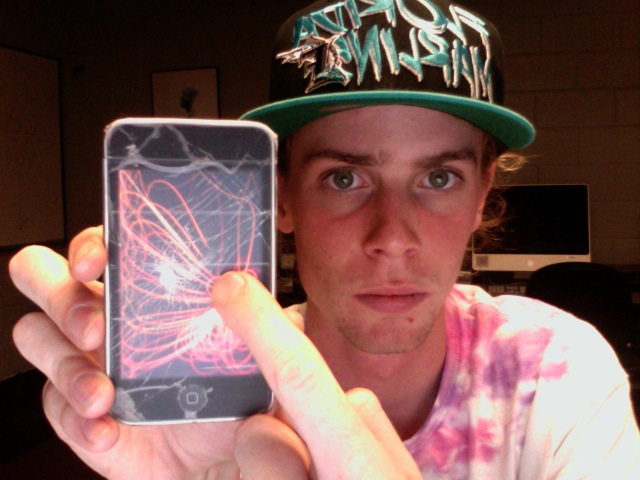
Picture of Ipod from which song was appropriated.
It is interesting to me how a different mood of narrative is created strictly by manipulating the sound. I would like feedback on these!!!!
Versions with Other Soundtracks
Sample 1
Sample 2
Thursday, September 22, 2011
New Progress!!!
Recently I have taken on my first video editing project involving forms of lens alterations. It is a loosely based narrative of a dream sequence.
Check it Out!!!
Looking for a Soundtrack, Any Thoughts?
The Most Amazing Time Lapse Video of Milky Way Ever Made. Seriously.
------------------------------------------------------------------------------------
Artist Levi Beamish Manipulates Scanner to get some really cool shots. I want to do this. Seriously.
If the embedding doesn't work follow this link.
Hope everyone is enjoying my first few posts. I appreciate questions and comments greatly!
Check it Out!!!
Looking for a Soundtrack, Any Thoughts?
Another Serious Film Project Worth Mentioning:
I found this video on http://www.stumbleupon.com, an internet search engine that allows you to browse media specific to your interests. Great way to get inspired.I don't know much about the artist but he/she seems to be interested in capturing what the eye cannot, the basis of our first project.The Most Amazing Time Lapse Video of Milky Way Ever Made. Seriously.
------------------------------------------------------------------------------------
Artist Levi Beamish Manipulates Scanner to get some really cool shots. I want to do this. Seriously.
If the embedding doesn't work follow this link.
Hope everyone is enjoying my first few posts. I appreciate questions and comments greatly!
Tuesday, September 6, 2011
Charles is Back on the Interweb
Hey Fans,
This blog is currently posting materials pertaining to Billy Friebele's Art Topics: Experimental Media Class in the Fall of 2011.
The Art That I did this Summer:
This summer, I tried to familiarize myself with digital photography and video by helping promote some musical artist with their promotion. I took video footage for a concert and helped supplement artwork for albums and a website. I tried to provvide my skills with graffiti style art by setting up a graffiti wall at one event.
This blog is currently posting materials pertaining to Billy Friebele's Art Topics: Experimental Media Class in the Fall of 2011.
The Art That I did this Summer:
This summer, I tried to familiarize myself with digital photography and video by helping promote some musical artist with their promotion. I took video footage for a concert and helped supplement artwork for albums and a website. I tried to provvide my skills with graffiti style art by setting up a graffiti wall at one event.
The event, All Bad Festival, took place on the same weekend as All Good Music Festival, a popular 3 day camping festival.
ARTISTS I'M LOOKING AT:
One artist that I read about over the summer and am currently interested in is David O'Reilly, an experimental digital artist who appears to fall right in line with class discussion thus far.
David O'Reilly is an experimental animator that choose to do his animation alone rather than with a team of designers. He chooses this method consciously taking shortcuts and allowing computer bugs to become visible in the artwork.
His images often contain 'trace elements' of the interface, poorly rendered polygon shapes, compression artifacts. He uses these elements to create a natural voice for the for the digital image which is designed to speak for itself in the same way that Jackson Pollock wanted the medium of paint to speak for itself in his splattered paintings.
Check Him Out!!! www.davidoreilly.com
Friday, May 7, 2010
http://www.youtube.com/watch?v=JqjKWEWI3ok
Johannes P. Osterhoff http://rhizome.org/profile.php?1067554
My last artist post is from www.rhizome.org and is probably the one that I have found the most enjoyable. Johannes P Osterhoff is an artist out of Berlin, Germany, who focuses on work with interfaces. This is a new spin on digital work because it works it a different way. Johannes creates life size “icons” and buttons that he finds aesthetically pleasing and then creates a real life art piece out of it. One of these pieces, for example, is the “submit button” which we are all familiar with but he replicates it in such a large size that you think of a different meaning of the word.
The most interesting piece that I found was a video called “windows real” in which people move around in a field holding large scale icons, recreating the default setting for windows. In the piece, he describes different actions you can do on the computer and then acts them out. The piece is rather humorous but also quite intelligent. The idea is outside of the box which lends it more credit than a typical youtube video.
I like the way that he is challenging the viewer to experience the usual stimulus in a completely different way. They did such a nice job collaborating to make the piece identical to Windows which takes a good bit of precision. I get a sense of a comment on the newer processing systems and the struggle to still ground your digital art in something more tangible.
All information taken from Rhizome Art Base.
Johannes P. Osterhoff http://rhizome.org/profile.php?1067554
My last artist post is from www.rhizome.org and is probably the one that I have found the most enjoyable. Johannes P Osterhoff is an artist out of Berlin, Germany, who focuses on work with interfaces. This is a new spin on digital work because it works it a different way. Johannes creates life size “icons” and buttons that he finds aesthetically pleasing and then creates a real life art piece out of it. One of these pieces, for example, is the “submit button” which we are all familiar with but he replicates it in such a large size that you think of a different meaning of the word.
The most interesting piece that I found was a video called “windows real” in which people move around in a field holding large scale icons, recreating the default setting for windows. In the piece, he describes different actions you can do on the computer and then acts them out. The piece is rather humorous but also quite intelligent. The idea is outside of the box which lends it more credit than a typical youtube video.
I like the way that he is challenging the viewer to experience the usual stimulus in a completely different way. They did such a nice job collaborating to make the piece identical to Windows which takes a good bit of precision. I get a sense of a comment on the newer processing systems and the struggle to still ground your digital art in something more tangible.
All information taken from Rhizome Art Base.
Subscribe to:
Posts (Atom)